The 30-second version
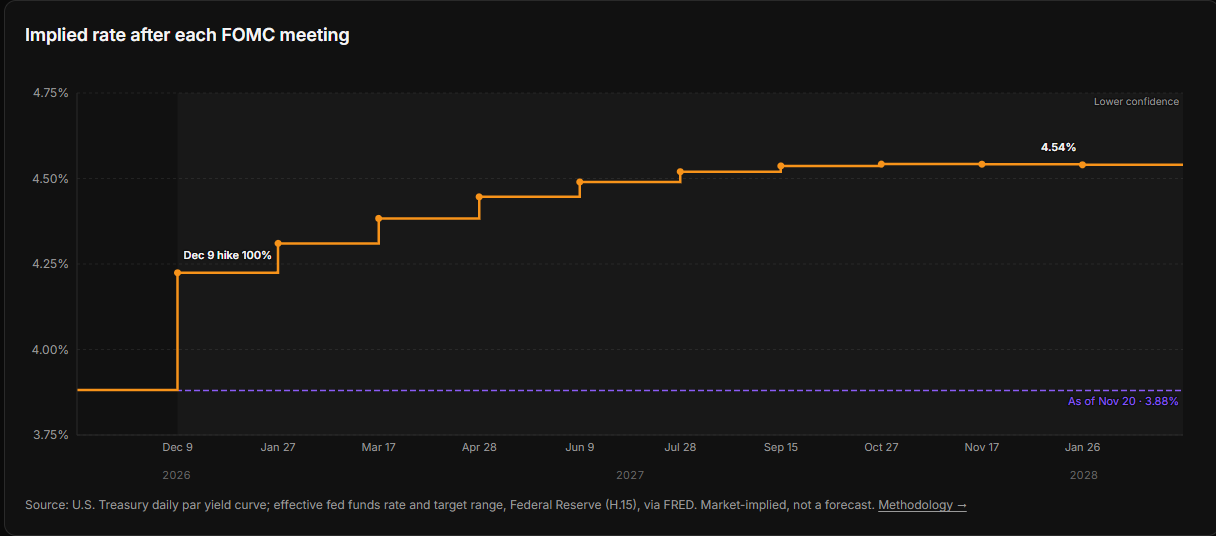
The bond market is sure the Fed raises rates on Dec 9. Now it thinks another hike in January is more likely too. But it took away some of the hikes after that. In short: hike sooner, fewer later. Why the shift? Growth is slowing, lenders are getting nervous, and last week money ran to safety.
First, a quick decoder
Market-implied odds: traders bet on the Fed's next moves through short-term Treasury bonds. RiskCurve's Fed Rate Expectations page reads those prices back as odds. It's what the market is pricing, not a forecast.
A quarter-point hike: the Fed's usual step, 0.25 percentage points. Traders call that 25 "basis points"; a basis point is one-hundredth of a percent.
What moved
As of Nov 23:
Dec 9: the market prices a 100% chance of a hike. There's a 38% chance it's a bigger half-point hike instead of the usual quarter-point.
Jan 27: the chance of another hike jumped to 34%, from 7% on Friday.
Further out: the Fed's rate ends up around 4.54% after the January 2028 meeting. That's about two and a half quarter-point hikes above today's 3.88%. Last week's Chart of the Week had about four.
So the market moved hikes closer and cut the ones after that. The jump in January hike odds came on Monday, the same day stocks rallied.
Why it matters: where we are in the cycle
I look at every chart through four lenses: growth, inflation, liquidity (how easy money is to get) and credit (how willing lenders are to lend). Here's where each one stands.
Growth: slowing, not shrinking. Tech stocks sold off last week as investors questioned what AI will really pay back, and how much it adds to the economy. Then a survey of businesses, the S&P Global flash PMI, fell to 54.6 from 55.9, its slowest pace since July. Anything above 50 still means growth. So this is a growth scare, not a recession. But people are starting to ask how long this run can last.
Then Monday flipped the mood. Nvidia's board brought back Jensen Huang as CEO, Nvidia jumped more than 30%, and the S&P 500 rose 4.7%, ending a seven-day losing streak. One big day doesn't settle the growth question, but it shows how fast the mood can swing.
Inflation: hot prices, but the market expects less. Consumer prices rose 0.4% in October, and 0.3% if you leave out food and energy. Both came in hotter than expected (BLS). Oil is off its highs but still expensive by historical standards, and those costs are still working their way through. The Fed paused in October anyway, so to me it's behind, and that's why the market wants hikes now.
Here's the twist: the market's own inflation expectation, the 10-year breakeven, fell to 2.13%, its lowest in a year.
Liquidity: a run to safety. Everyone wanted dollars. The dollar rose, foreign currencies fell against it, and gold, Bitcoin and stocks all sold off hard. Money went into safe government bonds instead. The 10-year real yield, what bonds pay after inflation, fell to 2.79%, from 2.92% a week earlier. That's the reverse of last week's post.
Credit: the one moving fastest. Junk bonds, the bonds riskier companies sell to borrow money, have to pay extra yield over safe Treasuries. That extra is the "spread". It jumped from 3.34% to 3.76% in the week to Nov 20 (ICE BofA US High Yield Index option-adjusted spread, via FRED). When it rises, lenders are demanding more to take the risk. It's still below the 4.61% it hit during the April 2025 "Liberation Day" tariff scare, but it's heading that way.
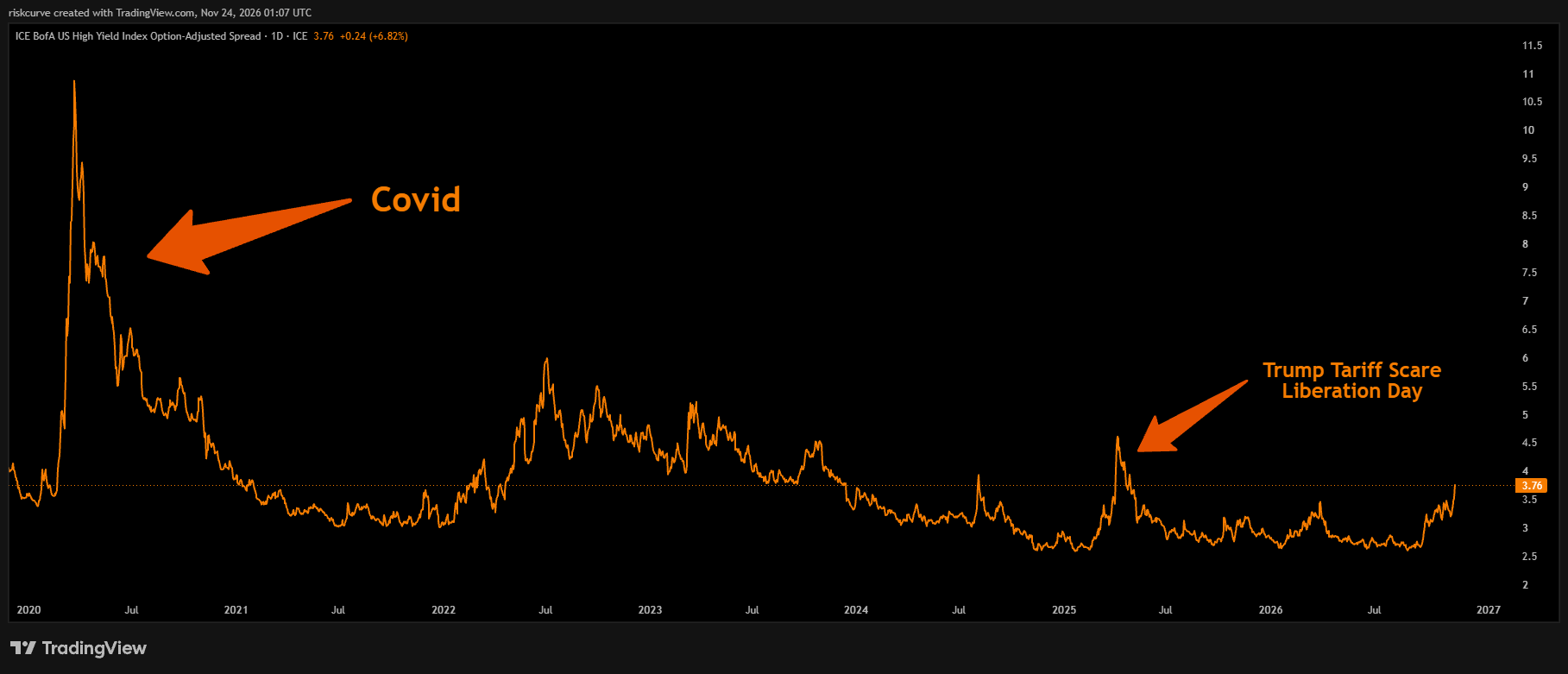
Zoom out and you can see the scale. Covid sent this spread above 10%, and the tariff scare sent it to 4.61%. The latest move is small next to both, but it's the sharpest rise since the tariff scare. The official measures on RiskCurve's credit spreads page haven't caught it yet, because they update monthly or weekly and run behind. These spread numbers run to Nov 20, before Monday's rally.
How it all fits (my take)
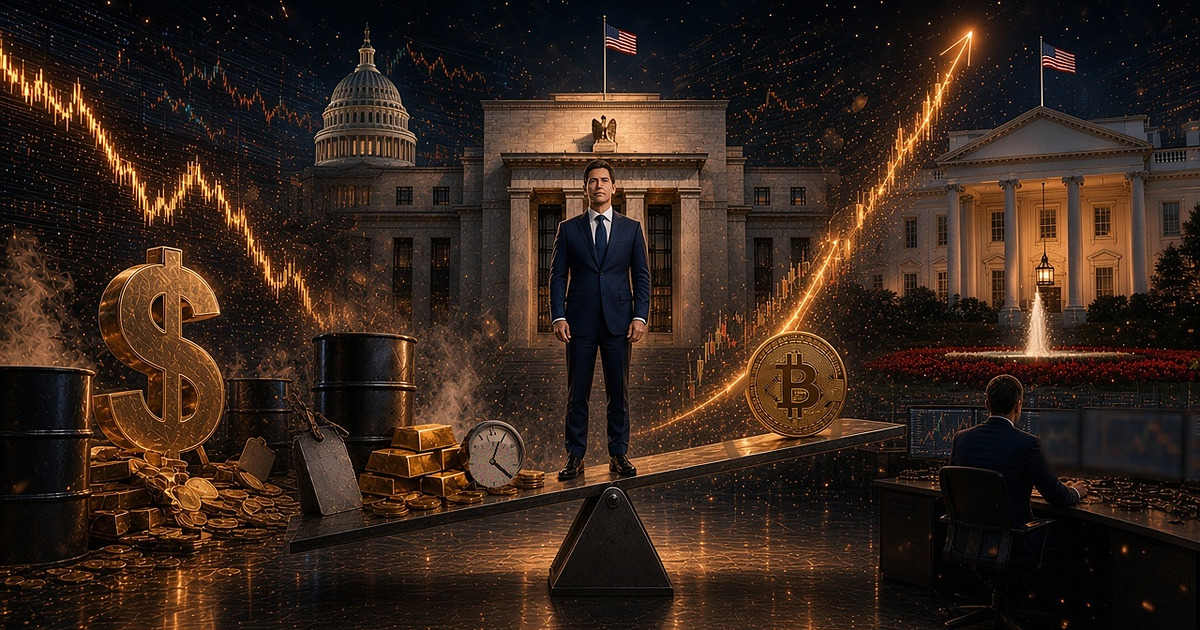
It's a seesaw. The forces in the system are pulling against each other. Hot inflation data pushes yields up, and slowing growth pulls them down. Inflation is eating into growth, and lenders are starting to ask who can pay them back.
The Fed has been too easy. In my view, it hasn't been tough enough on inflation.
The half-point hike? The market gives it a 38% chance. I'd put it lower. Yields aren't making higher highs, and inflation expectations fell over the past week.
Monday's rally fits the seesaw: one big up day after seven down. My read is still that risk assets, meaning stocks, crypto and junk bonds, move sideways or drift a little lower until something tips the balance. It could be Iran, Ukraine, higher rates, slower growth or earnings. Until one of them picks a direction, I'm staying neutral.
What I'm watching
It's a short week for Thanksgiving. Before the Fed decides on Dec 9:
Weekly jobless claims: how many people filed for unemployment.
ISM manufacturing and services surveys (Dec 1 and Dec 3): bigger surveys of factories and service companies.
The jobs report (Dec 4): how many jobs were added, and the unemployment rate.
One quirk: November's inflation report comes out Dec 10, the day after the Fed decides. So the Fed makes its call without seeing it.
Data: U.S. Treasury; Federal Reserve H.15 via FRED; ICE BofA US High Yield Index Option-Adjusted Spread, ICE Data Indices, LLC, via FRED; S&P Global flash US PMI; U.S. Bureau of Labor Statistics. Monday's rally: CNN, Bloomberg via Swissinfo. Live charts: Fed Rate Expectations, 10-Year Real Yield, Breakeven Inflation, Credit Spreads (market-implied path: RiskCurve calculation). High-yield chart made with TradingView. Education, not investment advice.