← Books
The Ultimate Tourist Guide To Bondistan

The Ultimate Tourist Guide To Bondistan

Efficient Market Hype

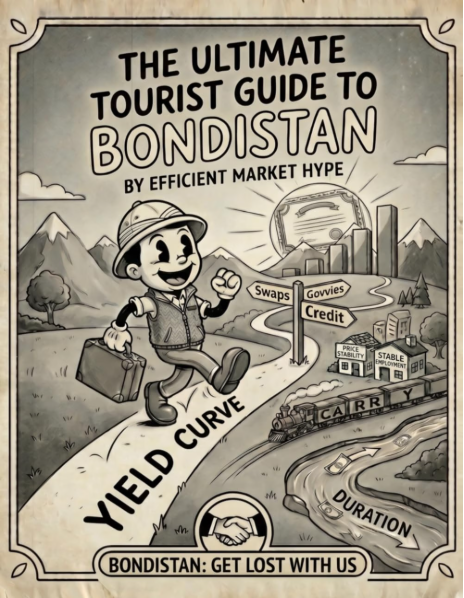
The Ultimate Tourist Guide to Bondistan started as a Twitter thread by Efficient Market Hype and grew into a practitioner's guide to fixed income. It shows how the tidy theory of bonds meets the chaos of real markets, and it ties the math back to real-world examples at every step. It won't teach you how to trade. It's for anyone who wants to understand how bond markets actually work, whether you're new to rates or you've been watching yields for years and want the theory behind what's on your screen.

Introduction

Added November 18, 2026

A practitioner's view of fixed income: how the orderly theory of bonds meets the chaos of actual markets.

Where the Book Came From

  • It started as a Twitter thread.
  • Much of the content came from Twitter, so it's still there.

What the Book Is (and Isn't)

  • Not a trading book: it won't teach you how to trade.
  • Theory meets reality: it shows the systems behind fixed income, then how the math and theory actually appear and apply in the real world.
  • Real-world examples: ideas are tied back to real market examples.

Mini Glossary

Added November 18, 2026

Bond and FX desks talk in shorthand. This is the phrasebook: how traders say sizes, measure moves and name what they trade.

Saying Size

  • M: thousand. Said "K" out loud.
  • MM: million. Said "buck" or "mill".
  • B: billion. Also called a "yard".
  • Watch out: on a desk, M means thousand, not million. "10MM" is ten million.

Measuring Moves

  • bp (basis point): 0.01%, so 100 bps = 1%.
  • DV01: how much a security's value changes when its yield moves by 1 bp.
    • Example (made-up numbers): with a DV01 of 1,000 dollars, a 5 bp move in yield changes the position's value by about 5,000 dollars.
  • Pip: the smallest move an FX pair makes, usually 0.0001.
  • Par: a bond price of 100, which is its full face value.

What Trades and Where

  • Cash: the actual security, like a stock or bond, as opposed to a derivative such as a future.
  • Govvies: government bonds, also called sovereigns.
  • OTC (over-the-counter): traded directly between two parties instead of on an exchange.
  • Spot: today's price or rate, as opposed to a future (forward) one.

Desk Talk

  • Colour: background or context on what's happening in a market.